Don’t miss anything! Sign up for my newsletter & join our Facebook community of 1,000+ like minded thinkers!
- Home
- Christianity vs Islam
Is Islam a Religion of Peace? Exploring the Foundations of Christianity vs Islam
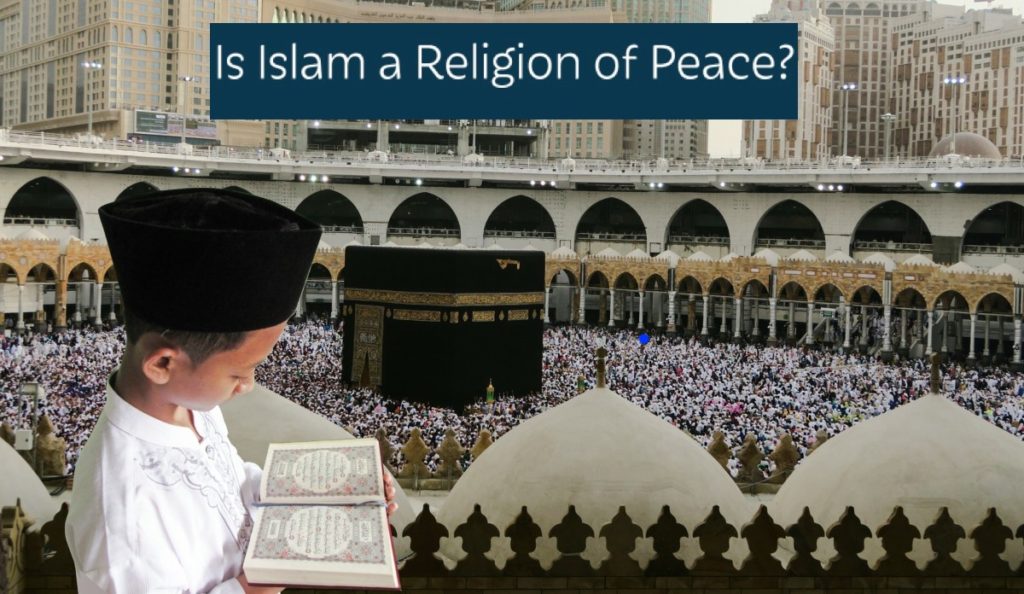
What makes a religion peaceful?
Is Islam a “religion of peace?”
How should we address this issue with wisdom, truth, and grace?
Now, please note, we cannot adequately understand and deal with this controversial issue without people being offended. But being offended does not make you or me right. We must look at the truth in the most objective way we can with grace and humility.
There is a difference between a person who claims to be a Muslim and the teachings of Islam (and there are many varieties of this teaching: Sunni, Shi’a, Ibadi, Ahmadiyya, and Sufism, to name a few!).
One can give a critique of one without necessarily insulting the other. Sadly, it is a question of maturity where a person is not able to understand a critique of the ideology that they follow and that of insulting them as a person or people.
So we must understand that a great many people cannot tell the difference between these two. With that said, we can either remain silent or speak up and trust God. Just like in Christianity there are many different interpretations of what Jesus said and meant, the same is true in Islam of Muhammad.
So what can we do to understand it? The best thing is to look at the primary texts yourself.
The psychological reason people cannot question this ideology, or any one that is powerfully connected to its society, language, and culture, is what psychologists call "groupthink." Groupthink is the practice of thinking or making decisions as a group in a way that discourages creativity or individual responsibility — and in tight communities, the person who goes against what a group thinks is ostrasized, abandoned, rejected, and in some cases killed. So it is dangerous to ask questions of an ideology that can and is interpreted by some of its followers to crush dissenting points of view about it.
With that said, we can ask this question of Islam and peace in a multitude of ways. To test this, we need to examine the teaching of Islam in the Qur’an and the hadith, and the life of its founder, its prophet, Muhammad.
In this podcast, I consider these questions. It is a lecture I gave on this issue in 2015 in Romania.
Prefer Listening?
Listen to the full podcast episode below for a deeper exploration.
Key Ideas in Brief
- Etymology of Submission: The word "Islam" is derived from the root for peace (Salaam), but its literal meaning is "submit," reflecting the posture of a soldier surrendering to a sovereign.
- The Meccan and Medinan Divide: The Quran contains two distinct phases of revelation: peaceful verses from Muhammad's time as a minority in Mecca, and more militant verses from his time as a political leader in Medina.
- A Misunderstood Trinity: The Quran mistakenly defines the Christian Trinity as consisting of God the Father, Mary, and Jesus, a concept that Christians also reject as polytheism.
- The Paradox of "Isa" (Jesus): While Islam denies the divinity of Christ, the Quran exalts Jesus significantly, noting his virgin birth and his role as the ultimate judge at the end of time.
- Ideology vs. Individuals: Most Muslims are peaceful people seeking good lives for their children, yet the political ideology of radical Islam often draws inspiration from the later examples of Muhammad’s life.
Defining the Terms: Peace vs. Submission
When discussing Christianity vs Islam, it is essential to begin with the linguistic foundation of the faiths. In the West, Islam is frequently marketed as a religion of peace. While it is true that "Islam" shares a root with the Arabic word Salaam (peace), the actual definition of the word Islam is "submit". This submission is total and all-encompassing, comparable to a soldier laying down his weapons before an over-powering enemy or a subject bowing before a king.
This posture is physically manifested in the Muslim prayer, where the mind — the most important part of the human person — is placed on the floor before God five times a day. While Christianity and Islam both emphasize the sovereignty of God, the Christian concept of peace (Eirene) often emphasizes a reconciled relationship and inner tranquility through Christ, whereas the Islamic concept emphasizes the external and internal order achieved through total surrender to Allah's will.
Similarities Between Christianity and Islam: A Shared Heritage?
There are undeniable similarities between Christianity and Islam, particularly in their historical and prophetic roots. Muhammad originally presented a message of monotheism intended for the people of Saudi Arabia, claiming it was the same message given to Adam, Abraham, and the biblical prophets.
Both faiths hold the following in common:
- Monotheism: A belief in one transcendent Creator.
- Prophetic History: Recognition of figures like Abraham, Moses, and David.
- Respect for Jesus: The Quran mentions Jesus (Isa) in 93 verses and affirms his virgin birth.
- The Afterlife: A belief in a final judgment and the existence of heaven and hell.
However, the divergence is sharp regarding the nature of God. The Quran categorically denies the divinity of Jesus Christ, viewing the claim of "Son of God" as a biological impossibility rather than a spiritual title of divinity.
The Two Faces of the Quran: Meccan and Medinan Verses
To understand the divergent views of Islam — the "peaceful" version promoted by many in the West and the "violent" version practiced by extremist groups — one must look at the chronology of the Quran. The text is divided into the Meccan and Medinan periods.
In the Meccan period, Muhammad was part of a religious minority. His teachings during this time focused on spiritual peace, social justice, and tolerance. However, after the Hijra (migration) to Medina, Muhammad became a political and military leader. The verses revealed during this period often reflect the needs of a growing state, including instructions for warfare, taxes, and the treatment of unbelievers.
This duality explains why a peaceful Muslim can quote a verse about the sanctity of life (Surah 5:32), while a radical group can justify violence using the very next verse (Surah 5:33), which prescribes execution or maiming for those who "wage war against God and His Apostle".
The Trinity and the Identity of the Angel Gabriel
One of the most profound differences in Christianity vs Islam lies in the perception of the Trinity. The Quran (Surah 5:116) suggests that Christians worship three gods: the Father, the Mother (Mary), and the Son (Jesus). This is a fundamental misunderstanding of Christian theology. Christians do not believe in three gods or biological copulation between God and Mary; they believe in one God in three persons — a unity in diversity.
Furthermore, the experience Muhammad had with the "Angel Gabriel" in the cave at Mount Hira contrasts sharply with the biblical accounts of Gabriel. In Islamic sources, Muhammad was so terrified by the encounter that he contemplated suicide. In contrast, the Gabriel of the New Testament appeared to Mary with a message of "rejoice" and "do not be afraid," specifically announcing that her son would be called the "Son of God" — a claim the Islamic Gabriel later vehemently denied.
Demographics and the Future of Faith
Islam is currently the fastest-growing religion in the world. While many attribute this to mass conversions, the data suggests it is primarily driven by birth rates. On average, Muslim families have a higher child-to-parent ratio compared to Christian families in the West.
However, as Muslims migrate to the West, demographic shifts often occur. Increased access to education for women typically leads to later marriage ages and a biological decrease in the number of children per household. This suggests that the "population explosion" feared by some may stabilize as cultural integration occurs.
Radical Christianity vs. Radical Islam
In addressing the violence of extremist groups like ISIS or Al-Qaeda, we must recognize that they are not merely groups of people, but proponents of a political ideology. While bombs and military force are sometimes necessary for national security, they cannot defeat an idea.
The lecture concludes that you defeat a destructive ideology with a better one. In the context of Christianity vs Islam, the ultimate "weapon" is the Gospel. While the history of the Christian church includes its own dark chapters of violence, the example of Jesus — who overcame the world through sacrifice rather than the sword — remains the fundamental contrast to the later warrior-example of Muhammad.
The Path of Truth and the Book of Life
The intersection of Christianity and Islam is perhaps best illustrated by the stories of those seeking peace in the midst of conflict. Consider the account of a man in northern Iran, a gunman who had been waiting at a gas station for three days. When a Christian pastor finally handed him a Bible, the man wept, revealing that an angel had appeared to him and promised that if he waited in that village, the "Book of Life" would be given to him.
Ultimately, the Bible is that "Book of Life" — a spiritual GPS intended to guide us through a world filled with trouble.
As we navigate these complex religious landscapes, we must hold fast to the promise Jesus gave: "In this world, you will have trouble. But take heart; I have overcome the world".
Exploring These Questions Personally
Some questions about faith and doubt cannot be resolved by arguments alone. They are lived, wrestled with, and experienced over time.
If you’d like thoughtful, non-judgmental ways to explore these questions more deeply, here are a few options:
Continue The Conversation
Wrestling with questions about God, faith, and meaning?
Join the newsletter for thoughtful reflections on belief, doubt, philosophy, and the search for truth, plus practical insights to live wisely, and believe courageously.