Don’t miss anything! Sign up for my newsletter & join our Facebook community of 1,000+ like minded thinkers!
Reason, God, and the Meaning of Life
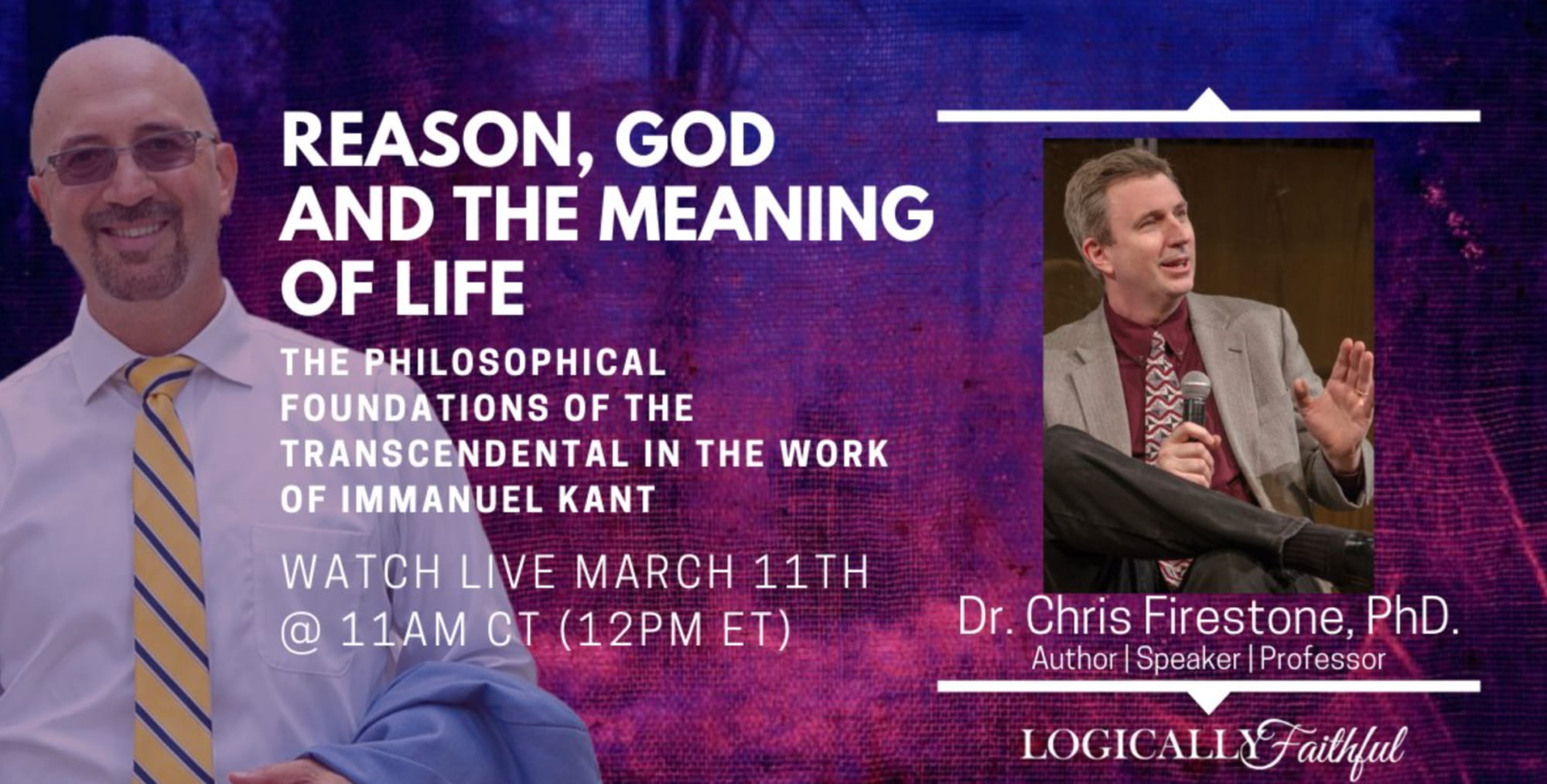
The Limits of Reason in Kant — Dr. Chris Firestone
What are the limits of reason in moral thinking and living?
How do we understand God in light of the critique of Immanuel Kant?
In this episode of LogicallyFaithful, Dr. Chris Firestone helps us see what we cannot with our eyes alone.
He is Chair of the Philosophy Department at Trinity International University and is the co-writer and co-producer of the short film Last Wish (2010) and the feature film Killing Poe (2017) and the author of Kant and the New Philosophy of Religion, coedited with Stephen R. Palmquist, Indiana University Press, 2006, Theology at the Transcendental Boundaries of Reason, Ashgate Publications Ltd., 2007, In Defense of Kant’s Religion, coauthored with Nathan Jacobs, Indiana University Press, 2008, Kant and Theology at the Boundaries of Reason, Ashgate Publications Ltd., 2009, The Persistence of the Sacred in Modern Thought, coedited with Nathan Jacobs, Notre Dame University Press, 2012, Kant and the Question of Theology, coedited with Nathan Jacobs and James Joiner, Cambridge University Press, 2016, Immanuel Kant: A Companion to His Philosophy and Its Prospects for Theology, Wipf &Stock, forthcoming 2021.
He is the father of five and most of all my friend.
This reflection is based on a podcast conversation exploring Kant’s understanding of reason, morality, and the question of God.
Key Ideas in Brief
- Kant argued that human reason has limits that cannot be overcome by logic alone.
- God cannot be proven or disproven by theoretical reason.
- Moral experience points beyond empirical knowledge to transcendent realities.
- Freedom, God, and meaning function as necessary assumptions for moral life.
- Kant reshaped the relationship between reason and faith rather than destroying it.
Prefer Listening?
Listen to the full podcast episode below for a deeper exploration.
Why Kant Matters in the Question of God
Before Kant, many philosophers believed that reason could prove God’s existence through logic and metaphysics. Kant challenged this assumption.
He argued that:
- Human knowledge is shaped by the mind’s structures.
- Reason cannot access ultimate reality directly.
- Traditional proofs of God overstep the boundaries of reason.
This was not an attack on faith, but a critique of philosophical overconfidence.
Kant forces us to ask a deeper question:
Are we trying to make reason do more than it is capable of?
The Limits of Reason in Kant’s Philosophy
Kant distinguishes between:
- Phenomena: the world as it appears to us.
- Noumena: reality as it is in itself.
We can know the first, but not the second.
This means:
- Science explains the empirical world.
- Metaphysical claims about God, the soul, and ultimate meaning lie beyond theoretical knowledge.
Reason, in Kant’s view, is both powerful and limited.
God After Kant: Beyond Proof and Disproof
Kant argued that God cannot be proven by pure reason. But he also rejected the idea that God is meaningless or irrelevant.
Instead, God emerges through practical reason—our moral experience.
For Kant:
- Moral obligations feel objective and binding.
- This suggests that morality is not merely subjective or evolutionary.
- The idea of God functions as a rational necessity for moral coherence.
God becomes not a scientific hypothesis, but a moral postulate.
Freedom, Morality, and the Meaning of Life
Kant believed that human beings must be understood as free moral agents.
Yet freedom cannot be empirically proven.
This creates a paradox:
- Science describes humans as part of nature.
- Morality demands that humans be responsible and free.
Meaning, therefore, does not arise from scientific explanation alone, but from moral responsibility and transcendence.
Kant’s philosophy suggests that the deepest questions of life are not solved by data, but by reflection on duty, freedom, and purpose.
Kant, Faith, and Modern Thought
Dr. Firestone emphasizes that Kant’s legacy is often misunderstood.
Kant does not eliminate faith.
He redefines its intellectual space.
He challenges:
- naive religious certainty that ignores reason,
- and reductionist rationalism that dismisses transcendence.
Kant invites humility—recognizing both the power and the limits of human reason.
Exploring These Questions Personally
Some questions about faith and doubt cannot be resolved by arguments alone. They are lived, wrestled with, and experienced over time.
If you’d like thoughtful, non-judgmental ways to explore these questions more deeply, here are a few options:
Continue the Conversation
Wrestling with questions about God, faith, and meaning?
Join the newsletter for thoughtful reflections on belief, doubt, philosophy, and the search for truth, plus practical insights to live wisely, and believe courageously.
You Might Like These
What Is God? The Attributes of God, a Philosophical Lecture
Explore the attributes of God in this philosophical study. Examine the Logos, divine holiness, and the nature of the Divine with Dr. Khaldoun Sweis.
Unity of Truth and the Plurality of Faiths
Do all religions worship the same God? This lecture explores religious pluralism, universalism, and unity of truth through a philosophy of religion perspective.
Hell, the Soul, and Evil with Richard Swinburne
The philosophy of hell and the soul explored with Richard Swinburne — and how these ideas shape Christian philosophy of the afterlife and human nature.