Don’t miss anything! Sign up for my newsletter & join our Facebook community of 1,000+ like minded thinkers!
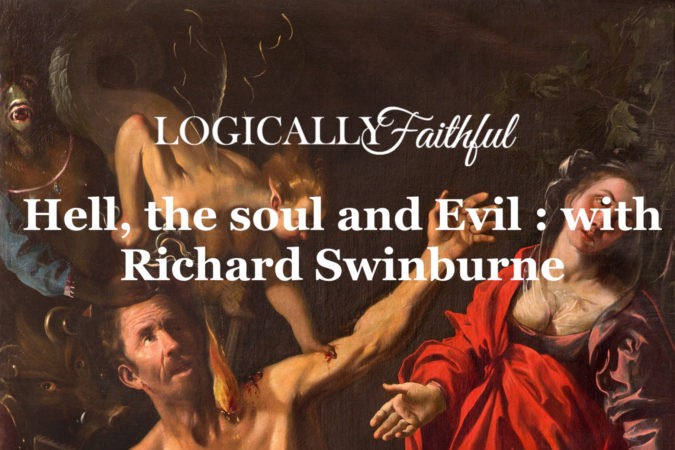
Hell, the Soul, and Evil with Richard Swinburne
Why believe in hell? Are humans merely physical beings, or do we possess an immaterial soul? And how should we think philosophically about evil, suffering, and free will?
In this extended philosophical interview, Professor Richard Swinburne — one of the most influential philosophers of religion of the modern era — explores the philosophical foundations of Christian doctrines surrounding the soul, evil, and the afterlife. Drawing on decades of work in philosophy of theism, substance dualism, and rational theology, Swinburne offers a careful defense of the soul’s existence, the moral significance of freedom, and the coherence of belief in hell.
This article draws on a podcast conversation exploring philosophical arguments about the soul, evil, free will, and the possibility of hell within a broader framework of rational theism.
Key Ideas in Brief
- Humans are not merely physical organisms but possess souls capable of conscious experience beyond the body.
- Substance dualism offers a philosophical framework explaining personal identity and moral responsibility.
- The existence of evil must be understood in light of genuine human freedom and the possibility of moral growth.
- Hell is approached philosophically as a consequence of free choice rather than arbitrary punishment.
- Moral responsibility requires genuine freedom, even when freedom allows for wrongdoing.
- Philosophical arguments for God help explain consciousness, moral awareness, and rational agency.
- The afterlife raises deep questions about justice, identity, and human flourishing.
- Suffering and evil must be evaluated within a broader narrative of moral development and eternal consequences.
Prefer Listening?
Listen to the full podcast episode below for a deeper exploration.
The Philosophical Case for the Soul
One of Swinburne’s most influential contributions is his defense of substance dualism — the idea that humans consist of both physical bodies and immaterial souls. This position challenges purely materialist accounts of consciousness and identity.
From a philosophical perspective, conscious experience presents challenges for reductionist explanations. Our thoughts, intentions, and subjective experiences do not easily reduce to physical processes alone. Swinburne argues that personal identity over time — the enduring “self” that remains through changing bodily states — points toward the existence of a non-physical dimension of human life.
The philosophy of the soul also intersects with moral responsibility. If human beings are merely complex biological machines, it becomes difficult to explain why individuals are genuinely accountable for their actions. A soul-centered account of personhood provides a framework for understanding agency, intention, and moral choice.
Substance Dualism and Human Identity
Substance dualism is not merely a theological claim but a philosophical proposal about the nature of persons. According to this view, a human being is not reducible to neural activity or bodily processes alone. Instead, the soul provides continuity of identity even when physical characteristics change.
This perspective addresses questions about life after death and personal survival. If identity depends solely on the body, the possibility of an afterlife becomes conceptually difficult. But if persons possess immaterial souls, survival beyond physical death becomes philosophically plausible.
Swinburne emphasizes that dualism is not anti-science. Rather, it attempts to account for features of human experience — such as rationality and self-awareness — that resist purely physical explanations.
Freedom, Responsibility, and the Problem of Evil
Any philosophical discussion of evil must grapple with human freedom. Swinburne argues that meaningful moral responsibility requires the real possibility of wrongdoing. A world in which humans could never choose evil would lack genuine moral agency.
From this perspective, the existence of evil is not necessarily evidence against God but may reflect the conditions necessary for meaningful freedom and moral growth. The ability to choose wrongly is inseparable from the ability to choose rightly.
Suffering and evil therefore raise profound philosophical questions about justice, compassion, and the purpose of human life. Rather than viewing evil as an isolated problem, Swinburne situates it within a broader narrative of moral development and the cultivation of virtue.
Philosophical Reflections on Hell
Belief in hell is often misunderstood as an arbitrary system of punishment. In philosophical theology, however, hell is more often understood as the consequence of persistent moral rejection rather than divine cruelty.
From this perspective, the afterlife reflects the culmination of free moral choices. If individuals are genuinely free, then the possibility exists that some may ultimately reject goodness itself. Hell thus represents a logical extension of human freedom rather than an externally imposed injustice.
Philosophically, the doctrine raises questions about justice, mercy, and the nature of divine love. How can eternal consequences be reconciled with compassion? Swinburne approaches these issues by emphasizing human autonomy and the moral seriousness of our choices.
Consciousness, Rationality, and the Existence of God
Swinburne’s broader philosophical work connects the nature of consciousness and rational thought with arguments for God’s existence. The fact that humans possess reason, moral awareness, and reflective consciousness may suggest a reality deeper than purely material explanations allow.
The laws of nature, the emergence of consciousness, and the existence of rational agents all contribute to a cumulative case for theism. Rather than relying on a single proof, Swinburne’s philosophy builds a probabilistic framework in which belief in God becomes a rational conclusion given the available evidence.
These ideas form the broader intellectual context in which discussions about hell, the soul, and evil must be understood.
The Moral Weight of Human Choice
Central to Swinburne’s philosophy is the conviction that human freedom matters deeply. Moral growth, spiritual development, and the search for meaning depend on the reality of choice.
A world without risk would also be a world without courage. A world without the possibility of wrongdoing would also lack genuine goodness. Freedom therefore stands at the heart of philosophical reflections on evil and the afterlife.
By emphasizing responsibility and agency, Swinburne encourages a view of human life in which actions carry enduring significance.
Exploring These Questions Personally
Some questions about faith and doubt cannot be resolved by arguments alone. They are lived, wrestled with, and experienced over time.
If you’d like thoughtful, non-judgmental ways to explore these questions more deeply, here are a few options:
Continue the Conversation
Wrestling with questions about God, faith, and meaning?
Join the newsletter for thoughtful reflections on belief, doubt, philosophy, and the search for truth, plus practical insights to live wisely, and believe courageously.
You Might Like These
Reason, God And The Meaning Of Life: Dr. Chris Firestone,PhD
Explore the limits of reason in Kant’s philosophy & what they mean for God, morality, and meaning of life in this conversation with philosopher Chris Firestone.
What Is God? The Attributes of God, a Philosophical Lecture
Explore the attributes of God in this philosophical study. Examine the Logos, divine holiness, and the nature of the Divine with Dr. Khaldoun Sweis.
Unity of Truth and the Plurality of Faiths
Do all religions worship the same God? This lecture explores religious pluralism, universalism, and unity of truth through a philosophy of religion perspective.